

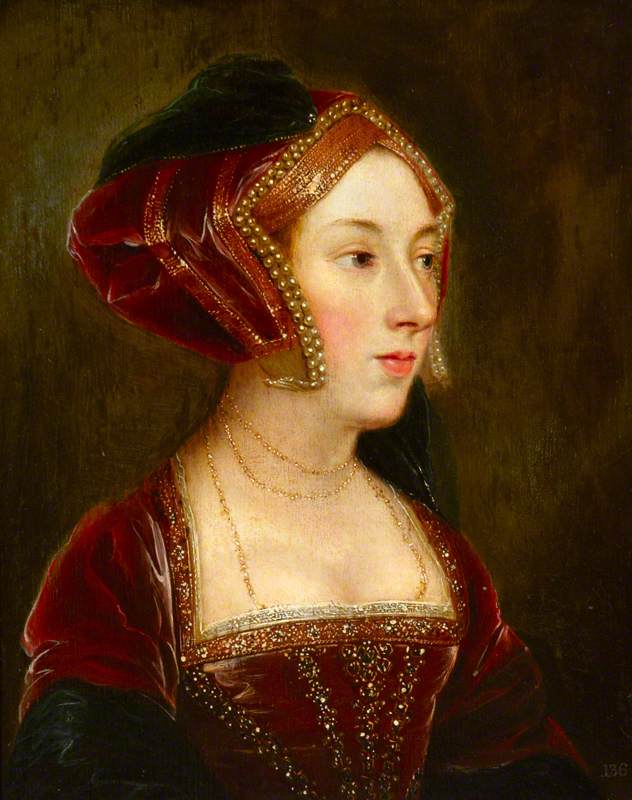
Today marks the 488th year anniversary of Queen Anne Boleyn’s execution and though she’s been gone for so long, people still know and speak of her. This isn’t going to be a very long post, so enjoy a brief history of Queen Anne Boleyn (who my cat, Boleyn, is named after).
She was the second wife of King Henry VIII, the King we’ve come to know as the one with the six wives. It’s been told so often that there’s even a musical about his wives (its called SIX the musical if you’ve never heard of it and I highly recommend).
Historians are uncertain of what year she was born; some say as early as 1501, others say as late as 1507 or 1509. She spent a good part of her childhood in France and in 1522 she returned to England and lived at Henry’s court.
She was to marry Henry Percy in 1523, but Cardinal Wolsey denied the match. Its been suggested that this was on behalf of the King, but as far as I know this isn’t a confirmed fact as King Henry first started paying attention to her in 1526.
In February or March of 1526 King Henry VIII started his long pursuit of Anne Boleyn. She resisted every attempt he made at making her his mistress. Her sister, Mary Boleyn, was once a mistress to the King. When that didn’t work, King Henry VIII started working on secret proceedings to obtain an annulment from his Queen, Catherine of Aragon, whom he was married to from 1509 to 1533. Henry was obsessed with Anne, and for a man who apparently didn’t like to write letters, he sure did write a lot to Anne. 17 of his love letters to her still exist and are preserved in the Vatican Library.
In order to marry Anne and divorce Catherine, King Henry broke England from the Catholic Church. King Henry and Anne were married in secret on November 14th, 1532, later formally married on January 25th, 1533. May 23rd, 1533 the Archbishop of Canterbury Thomas Cranmer declared King Henry’s marriage to Catherine of Aragon null and void. Five days later he declared Henry’s marriage to Anne valid.
I’m not going to get into all the details of their relationship, but I will say that my opinion based on what I’ve learned is that Anne really didn’t have a choice in the matter. He was the King, and she was a subject. I think she tried to make the best of her situation, which turned out to be a very bad situation.
In September of 1533 Anne Boleyn gave birth to the future Queen Elizabeth I. She then had three miscarriages, her last one just months before her untimely death.
January 1536, Anne Boleyn had a stillbirth of a son the day of Catherine of Aragon’s funeral. This event most likely sealed Anne’s fate.
By this time King Henry had found a new love interest in Jane Seymour.
On May 2nd, Anne was committed to the Tower of London on charges of adultery. These charges were fabricated so that Henry could rid himself of Anne. She was convicted on May 15th and four days later she walked to the scaffold. She was beheaded by a French swordsman in one clean swipe.
Good Christian people, I am come hither to die, for according to the law, and by the law I am judged to die, and therefore I will speak nothing against it. I am come hither to accuse no man, nor to speak anything of that, whereof I am accused and condemned to die, but I pray God save the king and send him long to reign over you, for a gentler nor a more merciful prince was there never: and to me he was ever a good, a gentle and sovereign lord. And if any person will meddle of my cause, I require them to judge the best. And thus I take my leave of the world and of you all, and I heartily desire you all to pray for me. O Lord have mercy on me, to God I commend my soul.
Anne Boleyn’s Speech at her execution
After being blindfolded and kneeling at the block, she repeated several times: To Jesus Christ I commend my soul; Lord Jesus receive my soul.
Recorded by Edward Hall (spelling modernized)
Historians view the charges against Anne Boleyn as unconvincing, especially with how quickly King Henry VIII married Jane Seymour on May 30th, just 11 days after Anne Boleyn died.
Today marks the 488th anniversary of Anne’s execution. She was the first Queen to be publicly executed, and she was only Queen for 1000 days. She met her end with grace and dignity. Her daughter Elizabeth became the Queen of England in 1558 died in 1603 marking the end of the Tudor era.
Sources used:
- “Anne Boleyn.” Tudorhistory.org, 2013, tudorhistory.org/boleyn/.
- “Anne Boleyn’s Speech at Her Execution.” Tudorhistory.org, tudorhistory.org/primary/speech.html.
- The Editors of Encyclopedia Britannica. “Anne Boleyn | Biography, Death, & Facts.” Encyclopædia Britannica, 7 Mar. 2019, http://www.britannica.com/biography/Anne-Boleyn .
- Wikipedia Contributors. “Anne Boleyn.” Wikipedia, Wikimedia Foundation, 7 Dec. 2019, en.wikipedia.org/wiki/Anne_Boleyn.
 Haven of History
Leave a comment